
How to Pay Off Debt Faster : Snowball vs Avalanche Explained
Credit cards, overdrafts, a car loan, buy now pay later, a catalogue account: debt has a way of piling up quietly until the monthly repayments take a big bite out of your income. If that sounds familiar, you’re far from alone.
The good news is that with a clear plan, you can pay it off faster than you think. This guide walks you through the two most popular methods, the snowball and the avalanche, and how to choose between them.
Step 1: Get the full picture
You can’t beat what you can’t see. List every debt you have, with:
- who you owe;
- the balance;
- the interest rate (APR);
- the minimum monthly payment.
Check your credit report too, through one of the main credit reference agencies, to make sure nothing is missing.
Step 2: Deal with priority debts first
Not all debts are equal. Priority debts are those where falling behind can have serious consequences, such as losing your home, having your energy cut off or facing court action:
- rent or mortgage arrears;
- council tax;
- gas and electricity;
- court fines;
- income tax or VAT owed to HMRC;
- child maintenance.
These come before credit cards and loans, even if the interest rate is lower. If you’re behind on any of them, get free debt advice straight away (see below).
Step 3: Always pay the minimums
Keep paying at least the minimum on every debt to avoid fees, extra interest and damage to your credit file. Then put every spare pound towards one debt at a time. Which one? That’s where the two methods differ.
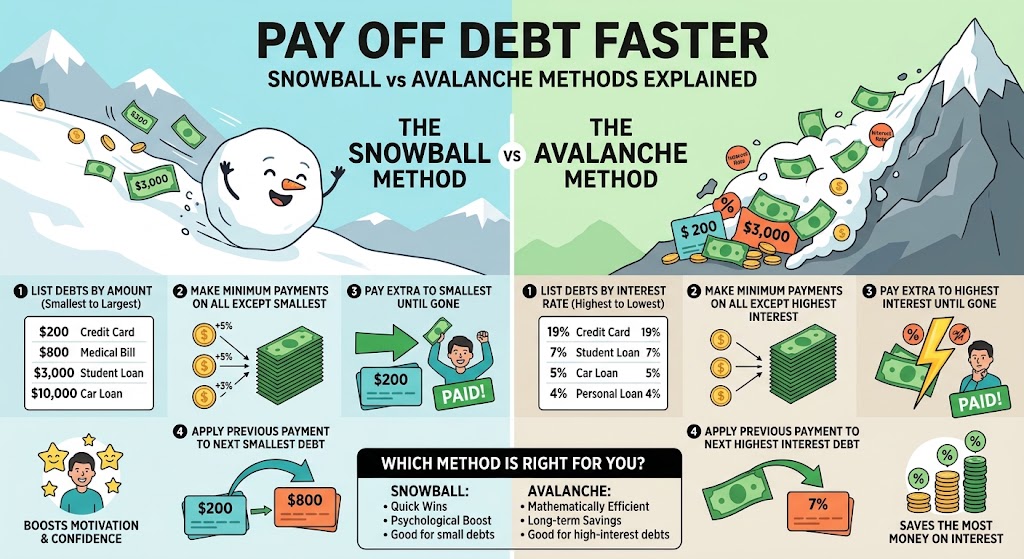
The snowball method
You pay off your debts from the smallest balance to the largest, regardless of interest rate.
- Pay the minimum on everything.
- Put all your extra money towards the smallest debt.
- When it’s cleared, add its payment to the next smallest.
- Repeat until you’re debt-free.
Why it works: quick wins. Clearing a debt completely in a few months is motivating, and that motivation keeps many people going.
The avalanche method
You pay off your debts from the highest interest rate to the lowest.
- Pay the minimum on everything.
- Put all your extra money towards the debt with the highest APR.
- When it’s cleared, move on to the next highest rate.
Why it works: mathematically, it’s the cheapest option. You pay less interest overall and usually finish sooner.
A worked example
Imagine you have £200 a month to put towards these debts, on top of minimum payments:
| Dettes | Balance | APR |
|---|---|---|
| Store card | £600 | 29% |
| Credit card | £3,000 | 24% |
| Personal loan | £5,000 | 9% |
- Snowball: you clear the £600 store card first, then the credit card, then the loan. It happens to match the avalanche order here because the smallest debt also has the highest rate.
- But if the store card were at 15% and the credit card at 29%, the avalanche method would target the credit card first and save you more in interest, while the snowball would still start with the store card for the quick win.
Which to choose? If you need motivation, choose the snowball. If you’re disciplined and want to pay the least interest, choose the avalanche. The best method is the one you’ll stick to.
Finding extra money to pay down debt
The faster you pay, the less interest you pay. A few ideas:
- Build a simple budget to see where your money goes each month.
- Cut or pause subscriptions you don’t use.
- Switch bills when contracts end: broadband, mobile, insurance, energy tariffs.
- Sell things you no longer need.
- Use a side hustle and put every penny it earns towards your debt.
- Direct windfalls (pay rises, tax refunds, bonuses) to your target debt.
- Check what you’re entitled to: benefits, discounts and council tax reductions you may be missing.
Should you keep a small emergency fund?
Yes. Without any savings, one unexpected bill can push you back onto your credit card. Many people keep a starter fund of around £1,000 while paying off debt, then build it up once the expensive debts are gone.
Balance transfers and consolidation loans
These can help, but only if used carefully.
Balance transfer credit cards
You move credit card debt to a new card with a low or 0% introductory rate for a set period. This can save a lot of interest, as long as you:
- check the transfer fee;
- pay off as much as possible before the promotional period ends;
- don’t build up new spending on the old card.
Debt consolidation loans
You take out one loan to pay off several debts, ideally at a lower interest rate. It simplifies things, but check the total cost over the full term: a longer loan can mean paying more overall, even at a lower rate.
Never consolidate unsecured debts into a loan secured on your home without independent advice: it puts your home at risk.
Free debt help in the UK
If your debts feel unmanageable, you’re behind on priority bills, or you’re borrowing to pay other debts, get free, confidential advice. Reputable free services include:
- StepChange Debt Charity
- National Debtline
- Citizens Advice
- MoneyHelper (government-backed)
They can help you create a budget, negotiate with creditors and explain formal options if needed. Be wary of companies that charge fees for debt solutions you could get free.
Mistakes to avoid
- Ignoring letters from creditors: contact them early, as most will work with you.
- Paying only the minimum forever: on credit cards, it can take many years to clear the balance.
- Borrowing more to pay debts without a plan.
- Closing paid-off accounts immediately without thinking about your credit file (this can affect your credit utilisation).
- Giving up after a setback: one missed month doesn’t cancel your progress.
Frequently asked questions
Should I pay off debt or save first?
Keep a small emergency fund, then focus on high-interest debt. Paying off a credit card at a high APR is usually a better “return” than most savings accounts.
Will paying off debt improve my credit score?
Reducing balances and paying on time generally helps your credit file over time.
How long will it take to become debt-free?
It depends on your balances, interest rates and how much extra you can pay each month. Listing your debts and using a free debt calculator gives you a realistic timeline, which is a great motivator.
Final thoughts
Paying off debt starts with facing the numbers. List every debt, deal with priority debts first, keep up the minimums, and then choose your method: the snowball for motivation, the avalanche to pay the least interest. If it all feels too much, free help is available, and asking for it is a smart move, not a failure.
This article is general information, not financial advice. If you’re struggling with debt, contact a free debt advice service.

0 commentaires