
Emergency Fund UK
The boiler breaks in January. The car fails its MOT. Your hours are cut, or you lose your job. Life has a habit of sending expensive surprises at the worst possible moment.
An emergency fund is what stands between those surprises and a credit card bill you’ll be paying off for months. It’s the foundation of any healthy financial plan, and it should come before investing.
Why an emergency fund matters
- It stops small problems becoming debt. Without savings, an unexpected £600 bill often ends up on a credit card or an overdraft, with interest.
- It gives you choices. A cushion means you can leave a bad job, handle a gap between contracts, or take time to find the right next step.
- It protects your investments. With cash set aside, you won’t be forced to sell investments at a bad time to cover an emergency.
- It reduces stress. Knowing you can cope with a surprise makes a real difference to everyday wellbeing.
How much do you need?
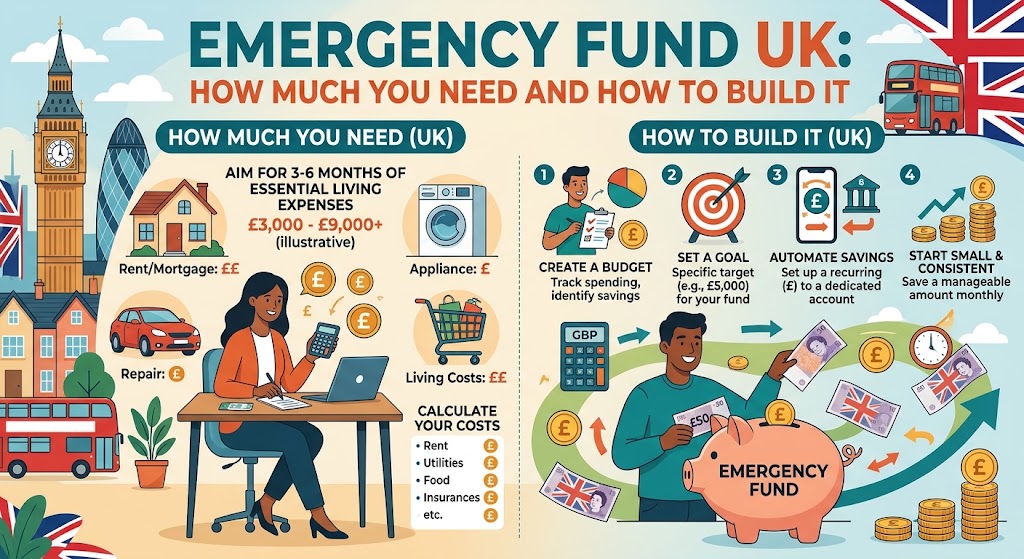
The common guideline is three to six months of essential spending. Not three to six months of salary: just what you need to cover the basics.
Calculate your essential monthly spending
Add up what you’d absolutely have to pay if your income stopped:
- rent or mortgage;
- council tax;
- energy, water, broadband and phone;
- food shopping;
- transport;
- insurance;
- minimum debt repayments;
- childcare and other essentials.
Leave out the nice-to-haves like takeaways, subscriptions and holidays.
Then adjust to your situation
| Your situation | Suggested target |
|---|---|
| Stable job, no dependants, renting | Around 3 months |
| Homeowner, or family with children | 4 to 6 months |
| Single income household | 6 months |
| Self-employed or irregular income | 6 months or more |
| Job in an unstable sector | 6 months or more |
Example: if your essential spending is £1,800 a month, a three-month fund is £5,400 and a six-month fund is £10,800.
If that feels impossible right now, don’t worry. Start with a smaller first goal: £1,000, or one month of essentials. That alone covers most everyday emergencies.
Where to keep your emergency fund
Your emergency fund needs to be safe, easy to access and ideally earning some interest. That rules out investments (which can fall in value right when you need them) and your everyday current account (where it’s too easy to spend).
| Option | Pros | Watch out for |
|---|---|---|
| Easy-access savings account | Instant or next-day access, simple | Rates vary, so compare regularly |
| Easy-access Cash ISA | Interest is tax-free | Check withdrawal rules and whether it’s a flexible ISA |
| Premium Bonds | Prizes are tax-free, capital-backed by the Treasury | No guaranteed return |
| Notice or fixed-term accounts | Higher rates | Not ideal for the whole fund, as access is restricted |
Check that your provider is covered by the Financial Services Compensation Scheme (FSCS), which protects eligible deposits up to a set limit per person, per banking licence.
A practical tip: keep your emergency fund at a different bank from your current account. It’s still easy to reach in a real emergency, but out of sight day to day.
Do you need to pay tax on the interest?
Most basic-rate taxpayers have a Personal Savings Allowance that lets them earn some savings interest tax-free. A Cash ISA keeps all interest tax-free regardless. If your emergency fund is large, a Cash ISA can be worth considering.
How to build your emergency fund
1. Set a first milestone
Start with £500 or £1,000, then one month of essentials, then three months. Small wins keep you motivated.
2. Pay yourself first
Set up a standing order to your savings account for the day after payday. Even £25 or £50 a month builds momentum.
3. Find the money
- Cancel subscriptions you don’t use.
- Switch broadband, mobile and insurance when contracts end.
- Sell things you no longer need.
- Put a side hustle’s earnings straight into savings.
4. Save windfalls
Pay rises, tax refunds, bonuses, birthday money: put at least half straight into your fund until you reach your target.
5. Use round-ups
Many banking apps can round up your card purchases to the nearest pound and save the difference automatically.
What counts as an emergency?
Yes:
- job loss or a sudden drop in income;
- urgent home repairs (boiler, leak, broken lock);
- essential car repairs if you need the car for work;
- unexpected medical, dental or vet costs;
- emergency travel for family reasons.
No:
- holidays, Christmas or birthdays (save for these separately);
- a sale on something you want;
- planned expenses you knew were coming.
After using your fund, make rebuilding it your first priority.
Emergency fund or paying off debt first?
A balanced approach works for most people:
- Build a starter fund of around £1,000.
- Pay off high-interest debts, such as credit cards and overdrafts.
- Then build your fund up to three to six months.
This way, a surprise bill doesn’t push you back into debt while you’re paying it down.
Frequently asked questions
Is six months of expenses too much?
Not if your income is irregular or your household depends on one salary. For others, three months may be enough, with extra savings invested for the long term.
Should I invest my emergency fund?
No. Investments can fall in value just when you need the money. Keep it in cash, and invest money beyond your emergency fund.
Can my emergency fund be in a Cash ISA?
Yes, as long as it’s an easy-access account. From April 2027, under-65s will be able to pay up to £12,000 a year into Cash ISAs, which is still enough for most emergency funds.
Final thoughts
An emergency fund isn’t exciting, but it’s the most important money you’ll ever save. Work out your essential monthly spending, set a first milestone, automate a monthly transfer, and keep the money somewhere safe and accessible. Once it’s in place, you can invest with confidence.
This article is general information, not financial advice. Interest rates and protection limits can change; check with your provider and the FSCS.

0 commentaires