

The Practical Guide to Taming Money and Freeing Your Future
Money is the tool we use most often, and probably one of the most powerful. Yet one fundamental question remains: do you control it, or does it control you? Understood properly, money is a wonderful servant. Ignored, it becomes a ruthless master.
Unfortunately, our consumer society and our school system fail to teach us how it works. We are constantly bombarded with encouragement to spend and conditioned to believe that investing is a complex art reserved for an elite of insiders. That is an illusion. In truth, of all the material things money can buy, one is worth infinitely more than all the others: freedom. That is the heart of JL Collins’ landmark book, The Simple Path to Wealth, popularised in the French-speaking world by educators such as Mathieu Ventour of Mind Parachutes. The book shows that the road to wealth and independence does not need to be winding. Simple does not mean easy, but the ideas are within everyone’s reach.
Why financial freedom is the only goal worth pursuing
Most people associate wealth with accumulating consumer goods: luxury cars, villas, the latest gadgets. Yet this vision of affluence is the ultimate trap that keeps you chained to a job that may not fulfil you. Real wealth is not measured by what you spend, but by the freedom of choice your assets give you.
Being in control of your time, being able to turn down an unreasonable assignment, choosing to stop working to raise your children or changing career without fear of tomorrow: that is what money invested wisely buys. Once you understand that every pound or euro you save is a brick in your future freedom, your relationship with spending changes radically. Money stops being something you exchange for short-lived objects and becomes the fuel of your independence.
The four pillars of healthy money management
There is no magic formula for building wealth. Instead, it is about following four guiding principles with iron discipline. They are disarmingly simple:
- Spend less than you earn: This is the essential starting point. Without a surplus, no wealth-building mechanism can get going.
- Avoid consumer debt at all costs: Consumer credit drains wealth. It destroys your future ability to invest by forcing you to pay punishing interest.
- Invest the surplus heavily: Saving in a current account is not enough, because inflation eats away at the purchasing power of your cash. Money must be put into productive assets.
- Keep it simple: The leaner your strategy, the fewer emotional mistakes you make and the less you pay in fees to middlemen.
How quickly you reach financial independence depends directly on one key indicator: your investment rate. The higher the share of your income you invest, the faster the bars of the professional cage will open. JL Collins suggests an ambitious investment rate of 50%. That may seem dizzying at first, but it becomes achievable once you clear your debts completely and adopt a frugal but fulfilling lifestyle. Every major life choice has a financial impact; understanding this lets you steer your path towards peace of mind.
The stock market: history’s most powerful wealth builder
When it comes to choosing a vehicle to grow your capital, the stock market has historically outperformed every other asset class (property, bonds, commodities) over the long term. Take a concrete and undisputed example: the US S&P 500 index, which groups the 500 largest companies in the United States. From its modern creation in 1957 to January 2025, this index delivered an average annual return of 10.3%, provided that dividends were systematically reinvested.
Why such performance? Because shares are not just lines of virtual code or lottery tickets. Behind every listed share there are real companies, infrastructure, patents and, above all, thousands of employees and managers working together every day to improve their products, optimise their services and grow their profits. The stock market also works as a form of natural selection: failing companies go bankrupt or leave the indices, while the most resilient and successful ones grow and pull the average upwards. Investing in the stock market simply means owning a share of global economic growth.
The illusion of active management: why the professionals fail
The most common mistake among beginner investors is trying to “beat the market”. They imagine they need to study charts for hours, spot the next revolutionary tech start-up or predict the exact moment markets will fall so they can sell, then buy back at the bottom. JL Collins is categorical: this approach, known as market timing or stock picking, is a dangerous illusion. Even Wall Street professionals cannot do it consistently.
The statistics are ruthless. A major 2013 study found that over a 15-year investment period, only 18% of actively managed funds run by finance professionals did better than a simple benchmark index. In other words, 82% of these highly qualified experts lost out to automated management. Over even longer periods, the failure rate approaches 86%. The reasons for this systematic underperformance are twofold: first, it is impossible to predict the economic future repeatedly; second, the high management fees charged by active funds eat into the saver’s final return.
The passive management revolution: the advantages of index funds and ETFs
Since beating the market is mathematically unlikely, the smartest and most profitable strategy is simply to copy it. This is where passive index funds and ETFs (Exchange Traded Funds) come in. These products simply track the performance of a benchmark stock index, such as the CAC 40 in France, the FTSE 100 in the UK or the S&P 500 in the United States.
Because they are passive, there is no need to pay fund managers huge salaries. As a result, ETF management fees are often 5 to 10 times lower than those of active funds. Lower fees mean more compound interest working for you. For investors living outside the United States, JL Collins and other financial experts recommend a global index fund (World or All-World). With a single click, this type of fund exposes your capital to all the world’s markets, giving you instant, maximum diversification at low cost.
Accumulation phase vs preservation phase: two strategies for one life
The path to financial independence falls into two distinct periods with opposite goals: the wealth accumulation phase and the wealth preservation phase. We tend to match the first with our working life and the second with retirement, but reality is much more fluid. In modern life, a person may move from one to the other through a personal choice (a sabbatical, starting a business) or one of life’s setbacks (redundancy, a health problem). While the fundamental principles stay the same, your portfolio allocation must adapt to these transitions.
Succeeding in the accumulation phase: maximising the growth of your wealth
During the accumulation phase, your main goal is to build and grow your capital as fast as possible. Your income comes mainly from your job or from a parallel project (a side business, an excellent income accelerator). To get through this phase at lightning speed, three major levers must be pulled at the same time:
- Paying off debt: Getting rid of high-interest debt is your absolute priority. It is the anchor holding your financial ship back.
- Optimising your investment rate: Cut unnecessary spending to maximise the gap between what comes in and what goes out. That surplus is what feeds your money machine.
- Choosing the right growth vehicle: The author advises putting 100% of your available savings (once you have built an emergency cushion for everyday surprises) into a global equity index fund.
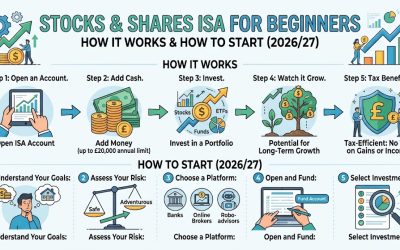
To make these investments tax-efficient, use the tax-advantaged accounts available where you live. In France, these include the PEA (Plan d’Épargne en Actions), assurance-vie and company savings plans (PEE), which have the significant advantage of employer top-up contributions. In the UK, the equivalent is the Stocks and Shares ISA and your workplace pension.
Taming volatility and keeping a cool head during market storms
If investing 100% of your savings in shares is the best-performing long-term strategy, why doesn’t everyone do it? The answer comes down to one word: emotions. The road through the stock market is never smooth. Periods of euphoria inevitably alternate with crashes and major systemic crises. Financial history is full of memorable shocks: the oil crises of the 1970s, the dot-com bubble bursting in 2000, the subprime crisis of 2008, the Covid-19 panic of 2020, and the Great Depression of 1929.
Seeing your hard-earned capital fall by 20%, 30% or 40% within a few weeks triggers deep fear in most people. This is where the trap closes: panicking and selling at the bottom to “limit the damage” is the worst possible mistake. That is the exact moment when a loss that was only on paper becomes real and permanent. To succeed, you must take on board an undeniable statistical truth: after every crisis, however deep, and even after two world wars, the financial markets have always recovered and gone on to set new record highs. Sometimes the recovery takes a few months, sometimes more than a decade. Keeping your nerve and continuing to invest regularly during the storm is the secret of wealthy investors.
The preservation phase: securing your gains and living off your investments
When your wealth has grown large enough to cover your lifestyle without you needing to work, you officially enter the preservation phase. Here, the paradigm changes completely. Your main goal is no longer maximum return, but stability, regular income and peace of mind. You must protect your capital from sharp falls while keeping it working to beat inflation.
This is the ideal time to adjust your asset allocation. To soften the volatility that comes with shares, JL Collins recommends adding bonds to your portfolio. Depending on your personal tolerance for risk, bonds can make up between 10% and 25% of your total holdings (for example, a classic allocation of 75% shares and 25% bonds). Bonds act as an emotional shock absorber: when shares collapse, the relative stability of bonds steadies the overall value of your portfolio and helps you avoid panic. As with shares, there is no point trying to pick individual bonds. A simple global or regional bond index fund, ideally in your own currency to avoid exchange-rate risk, will do the job perfectly. Your whole portfolio then comes down to just two products, an extremely simple set-up to manage day to day.
Applying the 4% rule so you never run out of capital
How do you know when you are technically free and can stop working? Theorists of the FIRE movement (Financial Independence, Retire Early) and JL Collins rely on a rule of thumb recognised around the world: the 4% rule. Drawn from an in-depth financial study (the Trinity Study), this rule states that if you withdraw 4% of your initial capital each year (adjusted annually for inflation), your wealth has a very high probability of lasting and never running out over a period of at least 30 years.
In practice, withdrawal rates of 6% or 7% might work in many favourable economic scenarios, but the cautious 4% limit was chosen to maximise your security and peace of mind, even if markets perform very badly early in your retirement. To apply the rule in reverse, simply multiply your annual spending by 25. If you think you need 30,000 euros a year to live comfortably, your capital target is 750,000 euros. Once you reach that amount, you are financially independent. If that figure seems intimidating at first, remember that the effort eases over time thanks to the magic of compound interest. After a few years, it is no longer your personal savings that grow your wealth, but your investments themselves, which generate and multiply on their own.
Conclusion: simplify your strategy today to free your future
Reaching financial independence is not a question of mathematical genius, luck or access to exclusive insider circles. It is the result of a series of rational choices, consistent spending discipline and an investment strategy stripped of all unnecessary complexity. By applying JL Collins’ philosophy of the simple path to wealth, you refuse to drown in the mass of opaque and costly options offered by the traditional financial industry. You take back direct control of your destiny.
The theory is now in your hands, but theory without action leads nowhere. What is the first concrete step you can take this week to clean up your finances and simplify your approach to money? Can you automate a monthly transfer into a tax-efficient account to buy a global index fund? Can you cut an unnecessary recurring expense to raise your investment rate? If you want to dramatically speed up building your wealth and boost your ability to save, starting a parallel activity or side business remains one of the most powerful levers of the 21st century. Assess your strengths, work out your entrepreneurial profile, and set out on the path to freedom without delay. Your future self will thank you.

0 Comments