
You started a side hustle last year: a few Vinted sales that turned into a proper reselling business, some freelance design work in the evenings, weekend deliveries or a small Etsy shop. It’s going well. Then January arrives, and with it the question every new side hustler dreads: do I need to fill in a tax return?
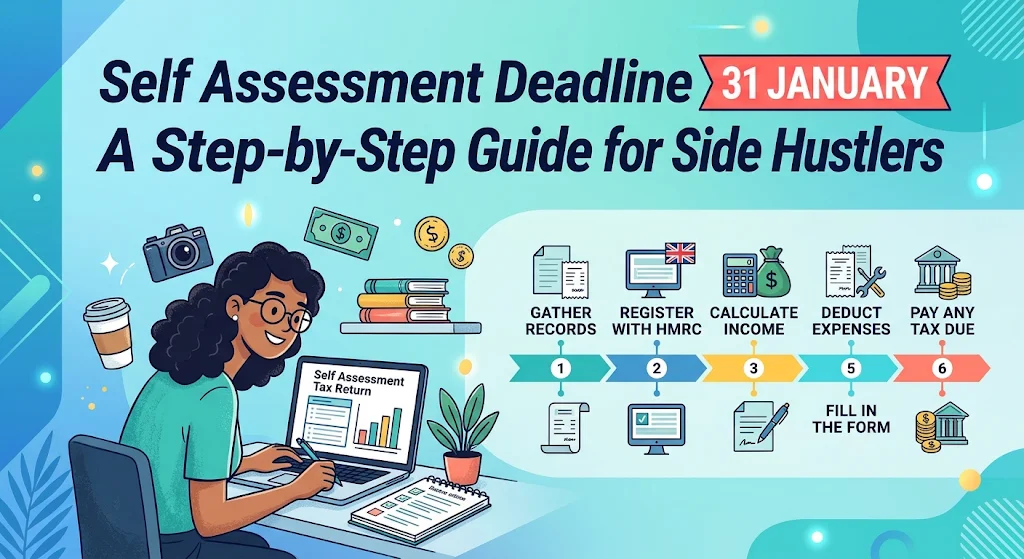
If the answer is yes, the key Self Assessment deadline is 11:59pm on 31 January 2027. That’s when your online return for the 2025 to 2026 tax year must be submitted, and when any tax you owe must be paid. This guide walks you through every step, from checking whether you need to file to pressing “submit”, without the jargon.
Self Assessment deadline dates for the 2025 to 2026 tax year
Click on a step to jump to the detailed section.
| Step | What it means | Key date |
|---|---|---|
| Register Tell HMRC you need to file | For first-time filers. If you missed it, register now: HMRC will give you a deadline 3 months from its letter | 5 October 2026 (passed) |
| Paper Paper tax return | Paper returns had to reach HMRC by this date | 31 October 2026 (passed) |
| Option Pay through your tax code | If you’re also employed, you may be able to have the tax collected through your PAYE tax code | 30 December 2026 |
| File & pay Online return and payment | Submit your online return and pay what you owe | 31 January 2027, 11:59pm |
| Advance Second payment on account | Only if you have to make payments on account | 31 July 2027 |
Do you actually need to file a tax return?
Not every side hustle triggers a tax return. The most important figure to know is the trading allowance of £1,000. If your total gross income from self-employment (before expenses) was £1,000 or less in the 2025 to 2026 tax year, you generally don’t need to tell HMRC or file a return for that income.
You usually do need to file a Self Assessment return if, for the 2025 to 2026 tax year, you:
- earned more than £1,000 in gross self-employed income (freelancing, reselling for profit, deliveries, content creation, tutoring…);
- received untaxed income such as rental income from a lodger above the Rent a Room limit, or certain foreign income;
- were a partner in a business partnership;
- had other circumstances that HMRC lists on GOV.UK (you can check with the official “Check if you need to send a Self Assessment tax return” tool).
Selling your own unwanted items (clearing out the wardrobe, selling an old phone) is generally not trading. Buying things to resell for profit, or making items to sell, usually is. If you’re not sure which side you’re on, read our guide “The Best Side Hustles in the UK for 2026/27 (and the Tax Rules You Need to Know)” or use HMRC’s checking tool.
Step 1: Register for Self Assessment (if it’s your first time)
If you’ve never filed before, you need to register as self-employed with HMRC. You’ll get a Unique Taxpayer Reference (UTR), a 10-digit number, and you’ll set up your Government Gateway account to file online.
- The registration deadline for the 2025 to 2026 tax year was 5 October 2026.
- Missed it? Register as soon as possible. According to GOV.UK, if you register after that date, HMRC will give you a return deadline 3 months from the date of its letter or email. But the payment deadline of 31 January 2027 still applies, and a “failure to notify” penalty may apply if tax is paid late.
- Don’t leave it until late January: your UTR and activation code arrive by post and can take time.
Step 2: Gather your records
Before you log in, put everything in one folder (paper or digital):
- Revenus: sales reports from platforms (eBay, Etsy, Vinted, Amazon), invoices to clients, payouts from delivery apps, bank statements.
- Expenses: receipts for stock, materials, postage, platform fees, equipment, software, a share of phone and internet used for the business.
- Your P60 or payslips if you also have a job.
- Other income: interest, dividends, rental income if relevant.
Good to know: online platforms now share sellers’ data with HMRC under international reporting rules, so it’s important your figures match what you actually received.
Step 3: Choose expenses or the trading allowance
You can either deduct your allowable business expenses from your income, or deduct the £1,000 trading allowance instead. You can’t do both for the same income.
- If your real expenses are less than £1,000, the trading allowance is usually the simpler, better option.
- If your expenses are more than £1,000 (for example, a reseller buying a lot of stock), claiming actual expenses usually reduces your tax more.
Step 4: Fill in and submit your return online
- Sign in to your HMRC online account with your Government Gateway user ID.
- Fill in the sections that apply: employment, self-employment, other income.
- Enter your turnover and either your expenses or the trading allowance.
- Check the tax calculation HMRC shows you before submitting.
- Submit before 11:59pm on 31 January 2027 and keep your submission reference.
Prefer software? HMRC-recognised accounting apps can prepare and submit your return and keep your records organised all year: [LIEN AFFILIÉ À AJOUTER]
Step 5: Pay what you owe
The payment deadline is also 31 January 2027. You can pay by bank transfer, debit card or through your HMRC online account. Remember:
- Your self-employed profits are taxed together with any salary. The first £12,570 of total income is usually covered by your Personal Allowance.
- Self-employed profits above £12,570 may also be subject to Class 4 National Insurance (6% on profits between £12,570 and £50,270 for 2025 to 2026, and 2% above).
- If you’re employed and owe less than £3,000, you may be able to pay through your tax code instead, as long as you file online by 30 December 2026.
- Can’t pay in full? HMRC offers Time to Pay arrangements. Contact HMRC before the deadline rather than after.
To set money aside automatically during the year, an easy-access savings pot works well: [LIEN AFFILIÉ À AJOUTER]
Payments on account: the surprise for second-year side hustlers
If your Self Assessment tax bill is more than £1,000 and less than 80% of your tax was already collected at source (through PAYE, for example), HMRC usually asks for payments on account: two advance payments towards next year’s bill, each equal to half of this year’s bill. The first is due on 31 January, along with your balancing payment, and the second on 31 July. This can make your January payment much bigger than expected, so check your calculation early.
What happens if you miss the Self Assessment deadline?
According to GOV.UK, the penalties for a late return are:
- £100 as soon as the return is late, even if you owe no tax;
- after 3 months, £10 a day, up to a maximum of £900;
- after 6 months, a further 5% of the tax due or £300, whichever is greater;
- after 12 months, another 5% or £300, whichever is greater.
Paying late adds penalties of 5% of the unpaid tax at 30 days, 6 months and 12 months, plus interest. If you had a reasonable excuse, you can appeal.
What’s changing: Making Tax Digital for Income Tax
From April 2026, Making Tax Digital for Income Tax started for self-employed people and landlords with qualifying income above £50,000, who now keep digital records and send quarterly updates. The threshold is due to drop to £30,000 from April 2027. Most side hustlers are below these levels, but if your side business is growing fast, keep an eye on it. Your January 2027 return for 2025 to 2026 is filed in the usual way.
FAQ: Self Assessment deadline
When is the Self Assessment deadline for 2025 to 2026?
For online returns, 11:59pm on 31 January 2027. The tax you owe must be paid by the same date.
Do I need to file if I earned under £1,000 from my side hustle?
Usually not, thanks to the £1,000 trading allowance, as long as that’s your total gross self-employed income and you have no other reason to file. Use HMRC’s online checker to be sure.
I missed the 5 October registration date. Is it too late?
No. Register as soon as possible. HMRC will give you a filing deadline 3 months from its letter, but try to pay any tax by 31 January 2027 to limit penalties.
Can I file my tax return on 31 January?
Yes, until 11:59pm. But HMRC’s helplines are very busy in January and you need your Government Gateway details ready, so aim to file well before.
What if I can’t pay my tax bill?
Contact HMRC as early as possible to discuss a Time to Pay arrangement. File your return on time anyway, to avoid the late filing penalty.
Conclusion: get it done before January gets busy
The Self Assessment deadline of 31 January 2027 is closer than it looks, especially with Christmas in between. Check whether you need to file, register if you haven’t, gather your records, choose between expenses and the trading allowance, then file and pay online. Doing it in November or December means no last-minute panic and no £100 penalty.
Sources: GOV.UK “Self Assessment tax return deadlines” and “Self Assessment tax returns: penalties” (checked 11 November 2026). This article is general information, not tax advice: check your own situation on GOV.UK or with a qualified accountant. This article may contain referral links: Onchop.co.uk may earn a commission at no extra cost to you.

0 commentaires