
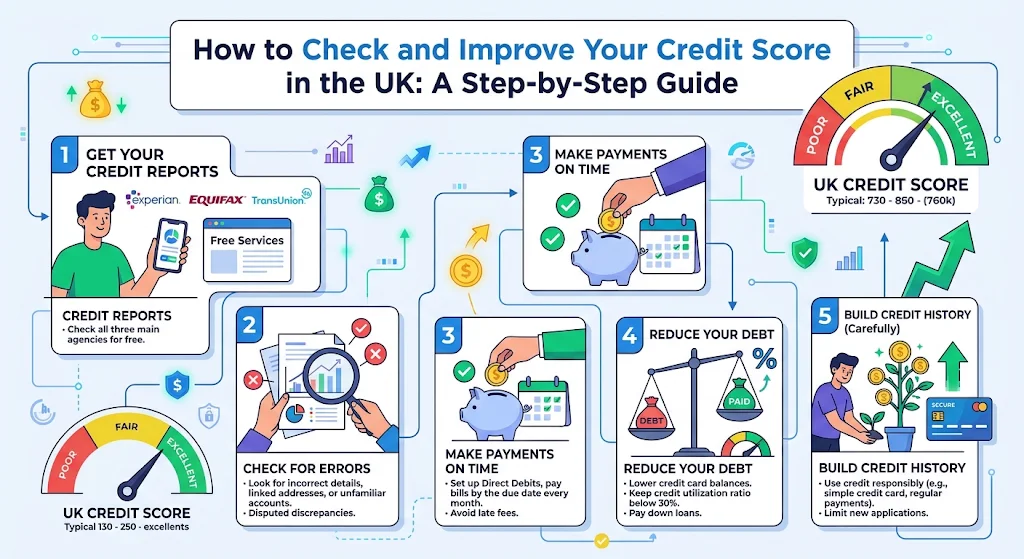
Improve Credit score uk
Whether you want a mortgage, a car finance deal, a credit card or even a mobile phone contract, there is one thing every lender looks at: your credit history. In the UK, your credit file can decide whether you are accepted, and also how much interest you will pay. A strong credit profile can save you thousands of pounds over a lifetime.
The good news is that your credit score is not fixed. With the right habits, you can improve it, often within a few months. This guide explains how credit scoring works in the UK, how to check your report for free and the practical steps that make a real difference.
How credit scores work in the UK
Unlike some countries, the UK does not have one single official credit score. Instead, there are three main credit reference agencies (CRAs):
- Experian
- Equifax
- TransUnion
Each agency collects information about how you manage credit and produces its own score, on its own scale. This is why your score can look different from one agency to another. More importantly, lenders do not see the score you see. They look at the information in your credit report and apply their own criteria. Your score is a useful guide to how lenders may view you, not a guarantee of approval.
What is in your credit report?
Your credit report typically includes:
- Your personal details and address history;
- Whether you are registered on the electoral roll;
- Your credit accounts: credit cards, loans, mortgages, overdrafts, mobile contracts, some utility accounts;
- Your repayment history, including late or missed payments;
- Defaults, County Court Judgments (CCJs), Individual Voluntary Arrangements (IVAs) and bankruptcies;
- “Hard” searches made by lenders when you applied for credit;
- Financial associations: people you share joint accounts or joint credit with.
Negative entries such as defaults or missed payments generally stay on your file for six years, although their impact fades over time as you build a positive record.
How to check your credit report for free
You have a legal right to see the information held about you by each agency, free of charge. There are also several free services that give you ongoing access to your report and score:
- Experian offers a free account with your Experian score.
- ClearScore shows your Equifax report and score for free.
- Credit Karma shows your TransUnion report and score for free.
Because lenders may use any of the three agencies, it is worth checking all three. Checking your own credit file is a “soft” search: it is not visible to lenders and does not affect your score.
Step 1: Get on the electoral roll
This is one of the quickest wins. Being registered to vote at your current address helps lenders confirm your identity and where you live. You can register online on the official government website. If you are not eligible to vote in the UK, you can add a note to your credit file, and providing proof of address to lenders can help.
Step 2: Correct any mistakes
Errors on credit reports are more common than people think: an old address, an account that is not yours, a payment wrongly marked as late, or a financial link to an ex-partner. Go through each report carefully. If you spot a mistake, contact the lender concerned and the credit reference agency to raise a dispute. They are required to investigate.
If you no longer share finances with someone you are linked to, you can ask the agencies to add a “notice of disassociation” so their credit behaviour no longer affects you.
Step 3: Never miss a payment
Your payment history is one of the most important factors. A single missed payment can lower your score and stay on your file for years. The simplest solution is to set up Direct Debits for at least the minimum payment on every credit card and loan. Then, pay more when you can.
If you are struggling to pay, contact your lender before you miss a payment. Many lenders can offer temporary support, and free debt advice services such as StepChange, National Debtline or Citizens Advice can help you find a way forward.
Step 4: Keep your credit utilisation low
Credit utilisation is the proportion of your available credit that you are actually using. If you have a credit card limit of £2,000 and a balance of £1,800, your utilisation is 90%, which can signal financial pressure to lenders.
A common recommendation is to keep utilisation below around 30%, and lower is generally better. You can reduce it by paying down balances, spreading spending across cards or, in some cases, asking for a higher limit (as long as you do not spend more).
Step 5: Build a credit history if you have none
Having no credit history can be almost as unhelpful as having a bad one, because lenders have nothing to assess. This often affects young people and those who have recently moved to the UK. Ways to start building a record include:
- A credit builder card: use it for a small regular purchase and pay it off in full every month;
- Having a mobile phone contract in your name and paying it on time;
- Services that let your rent payments be reported to credit reference agencies;
- Open banking tools that share your current account behaviour with an agency, with your permission.
Step 6: Space out your credit applications
Every time you formally apply for credit, the lender carries out a hard search, which appears on your file. Several hard searches in a short period can make you look desperate for credit. Before applying, use eligibility checkers, which most lenders and comparison sites offer. They use a soft search to show how likely you are to be accepted, without affecting your score.
Step 7: Keep old accounts open, if they are well managed
A long, well-managed credit history works in your favour. If you have an old credit card with no annual fee that you have always paid on time, it can be worth keeping it open and using it occasionally. Closing it shortens your history and reduces your available credit, which can raise your utilisation.
Step 8: Avoid payday loans and unnecessary credit
Some lenders view payday loans negatively, even if you repaid them on time. Similarly, opening lots of store cards or “buy now, pay later” agreements can complicate your profile, especially as more of these products are reported to credit agencies. Borrow only what you need and can comfortably repay.
How long does it take to improve your score?
There is no fixed timeline. Simple fixes such as joining the electoral roll or correcting an error can show results within a month or two, once the agencies update your file. Building a strong history through on-time payments and low utilisation takes longer, usually several months to a year. Serious negative marks such as defaults or CCJs will weigh on your file for up to six years, but their impact lessens as you add positive behaviour.
Common myths about UK credit scores
- “Checking my score lowers it.” False. Checking your own report is a soft search.
- “My partner’s bad credit affects me.” Only if you have a financial association, such as a joint account or joint loan.
- “Earning more improves my score.” Your salary is not recorded on your credit file, although lenders may consider it when you apply.
- “There’s a blacklist.” There is no credit blacklist in the UK. Each lender makes its own decision.
Conclusion
Improving your credit score in the UK is not about tricks, it is about consistent habits: get on the electoral roll, check all three reports and fix errors, never miss a payment, keep your balances low and apply for credit carefully. Start by checking your reports today. Within a few months, you could be in a much stronger position for your next mortgage, loan or contract, and pay less interest along the way.
This article is for general information only and is not financial advice. For help with debt, contact a free, regulated debt advice service.


0 commentaires